Image courtesy of the artist
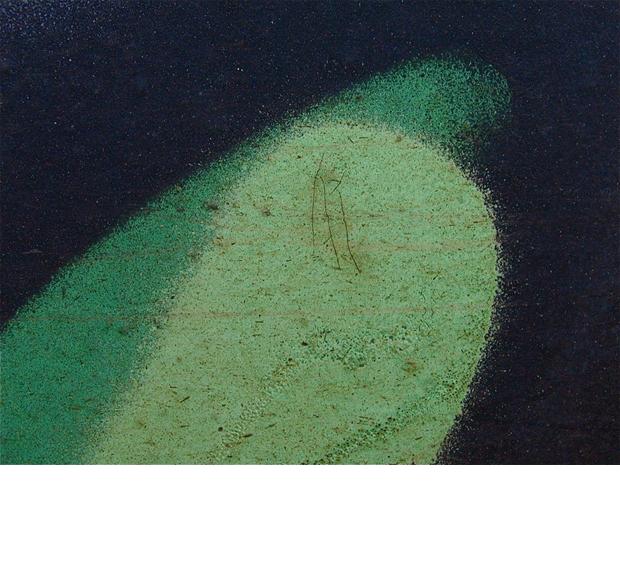
For those of you who do not know me personally, I am the fine arts librarian at a community college in south Louisiana. This week the college kicks off Arts Fest 2012. This is an annual event where the campus hosts a variety of art related activities, exhibitions, and shows for the next two weeks. We in the library have been receiving calls every day asking the location of the gallery. This is where a display of student paintings, prints, and drawings will be exhibited (they were setting it up on Saturday afternoon), and based on the number of calls people are very excited about this. Arts fest is also going to feature a visit by Louisiana artist Kathryn Hunter. An example of her instaltion art is pictured above. The full schedule of events can be read here.
Arts Fest is a celebration of all art forms. There's to be theater performances, music recitals, dance demonstrations, movies screened, and of course visual art. I enjoy the collaborative efforts to combine all the arts. Too often, particularly in academic settings, I believe there is an effort to compartmentalize the arts by discipline. However, when these forms of human expression are brought together the results are usually amazing, more so than when presented individually.
For example, I have provided the following video link:(link removed from internet, hopefully it will be replaced later)
This was a collaborative effort between Los Angeles singer Simone White, and her friend Hideyuki Katsumata. It was created as a response to the terrible earthquake that hit Japan one year ago. I find the images and the singing to be a haunting reminder of the power of nature. And I think the execution of this piece, with both music and printed animation, adds a great deal to what is being communicated.
Finally, I wanted to include a story and link about a dog house designed by Frank Lloyd Wright, even though it doesn't really fit with the theme of this post. The article can be found here. I enjoy this story. It's too bad Eddie never got to enjoy the house that was designed for him.
Showing posts with label Art. Show all posts
Sunday, March 11, 2012
Sunday, February 26, 2012
New Mona Lisa
JoaquĆn
Recently the art world was sent all a twitter by the discovery of a new Mona Lisa copy. Unlike previous copies though, it appears that this one was created along side the original in Leonardo's studio. The full article on this discovery can be read here.
Martin Bailey, the author, stated that there could have been any number of reasons for this to have occurred. He also stated that the work was most likely completed by a student studying under Leonardo, and that the close examination of this copy would shed new light on how Leonardo composed this famous painting.
I have never been a huge fan, however the Mona Lisa has fascinated other viewers for centuries. When I taught art history and art appreciation, no other single work of art was asked about more regularly than this one. With this new discovery more questions are sure to be raised. What I do find interesting is the hope to learn more about how Leonardo worked. All artists work differently and I think it is interesting to compare strategies and techniques.
Calls to Artists
Petroleum Paradox: For Better or For Worse?
Eligibility: Open to all US self-identified women artists.
About the Exhibition: Petroleum Paradox: For Better or For Worse is a collaborative exhibition with the Women’s Caucus for Art and Denise Bibro Fine Art. Please upload a current Bio and Artist Resume as the Denise Bibro Gallery will be promoting the artists selected and their work.
2012 Sequim Arts Juried Art Show
Sequim Arts, located in Sequim, Washington, is seeking entries for its annual juried art exhibit. Work in both 2D and 3D form will be accepted. Cash and merchandise prizes totaling over $1,500. The show will be hosted at the Museum & Arts Center in the Sequim~Dungeness Valley exhibit space and will run from May 1 to May 28.
Works on PAPER and of CLAY - 22nd Mid-Atlantic
The d'ART Center in Norfolk, VA is holding a Call to Artists for the 22nd Annual Mid-Atlantic Art Exhibition: “Works on PAPER and of CLAY”. This national art exhibition awards $3,200 in prizes! The juried exhibition is held at d'ART Center from April 27 - June 29, 2012.
Entry Deadline: March 6, 2012. Entry Fee: $30 for 5 entries.
2012 Maritime Art Exhibition & Sale' Call for Artists
International Deadline: March 15, 2012 - The Mackinac Arts Council of Mackinac Island, Michigan is pleased to announce an exhibition of maritime themed art to be held at the Mackinac Island Public Library June 30 to July 31, 2012. The submissions will be juried by the Mackinac Arts Council Jury Committee.
First Street Gallery, New York, Call for Artists: 2012 National Juried Exhibition
Eligibilty: Open to U.S. resident artists at least 18 yrs. old. Exception: Artists currently represented by First Street Gallery.
Eligible works include oils, acrylics, watercolors, pastels, drawings, prints and sculpture in any medium. No photography, video, film, installation, or mechanically reproduced artwork (computer, printer, giclees, etc.). The width of work, including the frame, may not exceed 30 inches. No height limit. Maximum weight of sculpture: 50 pounds. No wall hung sculpture. Sculptors must provide floor stand with a maximum footprint of 30″ x 30″. Maximum width or depth for sculpture is 30 inches. No height limit. All work must be suitably framed, wired and ready for hanging. Works on paper must be framed under plexiglass or glass.
Sunday, February 19, 2012
Christo Project in Colorado
The environmental artist Christo is working on another big project here in the United States. This time he wants to cover a few miles of the Arkansas River with a fabric canopy. NPR covered some developments in this project, and it is linked here.
Wolfgang Volz/Copyright Christo 2007
The NPR article discusses the major points of this project including the viewpoints of both those in favor of the project, and those against it. The author described how Christo works; creating sketches models and mock-ups of the project and then selling them to raise the funds necessary to put the project in place. Christo was interviewed and he again commented how the entire project is the art, including the people protesting, the permits, and everything associated directly or indirectly with the completion of the project.
I have always had a love/hate relationship with the work of Christo. On the one hand I can see the arguments that it is not art, and more a construction project. On the other, I like how Christo brings issues of land use into the realm of art. One thing is certain: he makes valid arguments in a creative way that really get people to respond, both positively and negatively.
Sunday, February 5, 2012
How an artwork develops
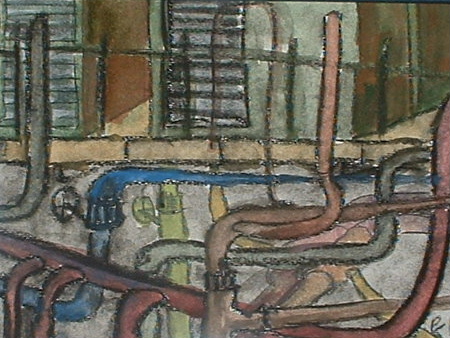
The above image is one of several that I sent off for exhibition in New York later this month. For this show I was looking at pipes. Each image is one relating to pipes, and the structures created supporting the movement of liquid though pipes. For this blog entry I could write all about my thoughts on pipes and why I was interested in creating a body of work focused on pipes, but I don't feel like posting that here. Most of that information is included in the artists statement for the exhibition, and I would rather write about how these images came together.
I spent the better half of the last month looking at pipes, thinking about pipes, and sketching pipes. I almost always have my sketch book close at hand, and for this show that frequently meant going out and sketching pipes. An example of these sketches is below.
This was one of the first sketches I made, and therefore one of the first paintings created for this show emerged from this sketch. Is it here.
I think it is interesting that for this project the first paintings nearly matched the sketches. As I got more involved in the the process however, the paintings began to deviate slightly from the sketches. Look at the example below.
This image was derived from the following sketch, but notice how it has slight differences.
From here I moved further into my own interpretations of the sketches I had made. For example this sketch:
helped to inform this image:
Some of the most interesting images, I think, are amalgamations of several sketches:
To be clear, the deviation from the sketches I made to the more imaginative paintings was not something that I conscientiously set out to do. I'm not sure why this happened, but I do think that the more I thought about pipes, the more comfortable I became in creating my own interpretation of their architecture. There were a few images in this set of paintings that I really like, including the one at the opening of this post, which is my favorite. This project has given me a lot to think about, not the least of which is how the more thought I put into an image, the more interesting it becomes.
Monday, January 16, 2012
The second two point post
The above video from YouTube is the first of a two topic post. A written article from NPR describing this sculpture in detail can be found here. There is much about this work that I find appealing. Not the least of which is how Chris Burden (the artist) describes this as a means of getting away from the work he normally does. Burden typically works in conceptual/performance art. Taking time to get away from how one typically works and "playing" was the theme of last weeks post, and it is good to see others out there with a similar philosophy to my own.
Playing is an integral element of this sculpture, and for me, a sense of fun is derived from simply observing the video. I also like how something as simple as gravity and free-rolling cars can recreate the visual chaos of everyday humanity. The noise, the movement, and the cyclical nature of the cars endlessly looping are very descriptive of life in the city.
Courtesy Andrea Fuhrman
The second topic of this post relates to graffiti art. There is much written about graffiti art, with some artists even gaining recognition for their works. Bansky is but one example. The article, linked here, examines graffiti differently. Here images painted on railroad cars are examined, and then micro images are created from them. Andrea Fuhrman, the artist who produced this work, described how she got interested in working this way. Her insights are unique, and I found her story of how she became an artist interesting. The paths we take as artists, and what has lead us to them is always different, and I think it is partially what shapes each individual artistic vision.
Tuesday, January 10, 2012
Personalized Project
I think it is important for artists to experiment and explore different ways of working without feeling pressured to produce a finished, museum quality work. I would add that artworks produced through "play" are just as valid as those works produced for exhibition. I recently adopted this approach in a self-imposed project that lasted from Dec 6 through January 6.
My goal was to complete a self-portrait everyday for 30 days. I allowed myself the opportunity to use any medium in any size. It had also been a while since I worked directly with dry media, so most of my images were drawings. Portraiture has always been a weakness of mine, so I felt that this project would afford me the opportunity to sharpen my skills in this area.
On the surface, the resulting images are terrible. Two examples can be seen below.
However, the value of these images is found not in the finished product, but rather in the process that created them. If you are looking for a new way of working, or just want to try something you have not done in a while, I recommend developing a project of your own.
Tuesday, January 3, 2012
When does an artwork fail?
Happy New Year!
I had planned on posting this before the holidays, but I was travelling and things got away from me. On a recent visit to an academic institution I observed the following:
This got me thinking about the success of visual works of art, and when and how they fail. I think a work fails when it becomes acceptable to place a giant planter full of plants, and all kinds of information boards in front of the work.
I commented on this to a friend who was with me at the time, and she stated that in the many years she had visited this institution, she had never noticed that sculpture before. How long has it been there? How long has it been completely ignored by all who chance to see it?
I tried to find out more about the sculpture, by the attempted examination of the placard on the wall adjacent to the object. This was difficult because of all the items blocking the path. I managed to snap a quick photograph of the placard however. The quality is not that great due to limited space restrictions caused by other objects. It can be viewed below.
This post is not meant merely as a criticism of those that own the art. They have their reasons for posting information in that area. It could also be argued that this is a rationale for the periodic exchange of new works in any given space. A fresh update of several works a year would revitalize the area and provide a different feel each time the work was switched out. Rather, this post is meant as reflection on when a work of art has become tired, and has failed to capture the interest of the viewer.
As artists it is our job to communicate with the observer. Part of this conversation takes place in the context of how the art work is presented, which may or may not be in our control. However, the value of what is expressed in the work is under our control, and it is this issue that artists must focus on.
Upcoming Calls to Artists
January 31, 2012 INTERNATIONAL WOMEN'S PHOTOGRAPHY EXHIBITION $3000 in
cash awards; valuable prizes provided by Datacolor, global leader in
color management solutions and color communication technology; a group
show in Manhattan's .NO gallery; an online exhibition and a feature
article in IMPRINTS Magazine Spring/Summer 2012 issue. All mediums,
styles and schools of thought to participate. Experimental and mixed
techniques are welcome. Only 2-D work is eligible. Entry
fee. Click here for more info.
January 30, 2012 CALL FOR SKETCHBOOK PROJECT ENTRIES Art House Co-op
is proud to announce our brand new project: The Limited Edition
Vol. 1! The Limited Edition is a collaborative series of art books
created by 5,000 artists from across the globe. Anyone from
anywhere in the world can participate in the project. Sign up to
receive a blank sketchbook in the mail, then fill it up and send it
back. Your work will be cataloged in the Brooklyn Art Library in NYC
and published in the Limited Edition art book series. Entry
fee. Click here for more info.
February 1, 2012 INTERNATIONAL REALIST PAINTING COMPETITION In
addition to scholarships and hosting the largest online museum
dedicated to traditional painting, we hold one of the most prestigious
competitions for living artists who paint in the realist
tradition. This year we are offering $50,000 in cash awards including
$10,000 for Best in Show. Participants can compete in 6 categories:
Figurative, Landscape, Animals, Still life, Sculpture, and
Drawing. This year we are also introducing five new awards designed to
encourage creativity and ambition in the arts: Most Creative, Best
Social Commentary, Best Portrait, Most Ambitious Work, and Best Trompe
L'oeil. More info here.
March 31 2012 The St. Tammany Art Association announces the 47th National Juried Exhibit July 7-August 11, 2012. Juried by Miranda Lash, Curator of Modern and Contemporary Art at the New Orleans Museum of Art. $2,500 in awards. E-mail info@sttammanyartassociation.org, call (985)892-8650, or send SASE to St. Tammany Art Association, 320 N. Columbia St., Covington, LA 70433. More info here.
Tuesday, October 4, 2011
Ways to be an artist
As the librarian in charge of the fine arts collection, I have created an online guide meant to help art students, faculty, and those wishing to browse in this area of the library. Some sample screen shots are included.
In this guide I have included information on how to find books and materials, appropriate databases related to art research, and sample images of titles in the collection. Links to Web Sites that might be useful are also included. In addition, there is information on how to contact the library, librarians, and request items to add to the collection.
A link to the guide can be found here.
I posted this guide to illustrate just one example of the numerous ways artists can practice their art making and not go the route of the "starving artist." Several years ago, after completing my BFA, I thought the only other route to viably producing art was to teach. I believed that in order to teach a subject one would have to maintain a steady practice of that discipline, and thought that teaching art would allow me the opportunity to continue this process.
While teaching art courses, at any level, certainly offers artists a steady income and the ability to learn vicariously through the students, it is not the only way. Throughout my undergrad and graduate studies I worked in different libraries, first as a student worker, and then in other roles. During this time I became aware of the Art Library Society if America (ARLIS/NA) and of art librarianship. I enjoyed the library environment, and the ability to combine art and libraries was very appealing. I enrolled in library school, and have now joined the ranks of librarians and information professionals devoted to the arts.
But there are still other ways. Part of my studies in library school included an internship at the Hanson Library in the Birmingham Museum of Art (mentioned previously in this blog). This experience exposed me not only to the professional world of a special library, but I also had the opportunity to interact with other departments and people within the museum. These people are also very active in the visual arts and have the same opportunities to learn, grow, and practice art making as those who teach.
There are those who may argue that taking one of these routes removes the artist from the studio. However, I have stated before that much of what makes the work of an artist valuable is the experiences that he/she has put in to the work of art. Creating art is a process that includes observation and experience as much or more as it does time in the studio making art. Art is not created in a vacuum and exposure to the resources in libraries and museums helps build a framework, a background, and a context from which to speak.
One other thing that I would like to start including in these postings is a list of calls to artists. I am on several listservs for such calls, and it would impossible to participate in every one. But by posting some of those opportunities here, perhaps you could find one of interest and participate yourself. Here are three such opportunities:
1. DEADLINE: Fri, October 28, 2011
3rd Ward Open Call for Art
Location: NY
Artists, This could be the next step in launching your career. You’re invited to join the 3rd Ward Fall 2011 Open Call, an international search for exciting, innovating and compelling artwork awarding over $25,000 in prizes, including a one month live/work residency in NYC, a $5,000 grant and your very own New York City solo exhibition. http://www.3rdwardopencall.com/?f=pam1 Plus, all participants will be considered for the $1,000 People's Choice Award Awarded to the artist whose portfolio garners the highest number of public votes.
www.3rdwardopencall.com/?f=pam1
2. DEADLINE: Tue, November 01, 2011
8th Biennial National Art Juried Exhibition
Location: FL
Punta Gorda, FL. Open to all traditional two-dimensional drawing and painting media. Juror: Dean Mitchell, A.W.S., N.W.S. Digital entry deadline Nov. 1, 2011. Show dates Feb. 4-Mar. 11, 2012. Prize total $6500. Prospectus: www.visualartcenter.org. Questions: vac@daystar.net. Located on Charlotte Harbor off Gulf Coast.
www.visualartcenter.org
3. DEADLINE: Thu, December 01, 2011
Flora and Fauna: Narrative through Icongraphy
Location: NY
Flora and Fauna: Narrative through Iconography A juried exhibit at Lockhart Gallery, SUNY Geneseo For generations, artists have used signs and symbols from nature to impart meaning in their artwork. Audiences of previous eras were well-versed in this seemingly covert language. Each icon usually has several different meanings; for instance a rabbit may mean fertility, longevity, femininity or rebirth. . . For more information go to: geneseo.edu/galleries/flora-and-fauna
www.geneseo.edu/galleries
Sunday, September 25, 2011
Update on last week, and thoughts on art education
As you can see from the image, I am back up an running. This is a painting that I started earlier this summer, but never finished. I'm glad to be working again, when I do not make art I get cranky. I think this will be the last of the large-scale flower images (at least for a while). It might be an interesting idea to pursue later, but for now it's time to let that idea rest.
The second part of this posting is going to be devoted to thoughts on arts education. In the UK options are being weighed for the elimination of arts programming in some schools. For more specific information click here. New curricula are being formulated that center on math, English, science, foreign languages and either history or geography.
While these subjects are important, I do not believe they should be the sole focus of an education program. In the article linked above, the director of learning at the Tate Museum stated that courses in art bring students into alternative ways of thinking and addressing problems. She stated that this is needed in contemporary times and that western society has always valued innovation going back to the Renaissance.
I agree with these statements. The arts develop creativity, and with creativity new directions in subjects like math, English, science etc. are realized. When I was teaching art appreciation, one of the things I tried to impart was how connected the arts are to everyday human thought and interaction. Students were often amazed when this was pointed out, and it was from this teaching experience that I learned how this occurs on a subconscious level. Until it was pointed out to them, students did not realize how art shapes individual thought and opinion. After the fact, I noticed that students were drawing these comparisons on their own and bringing a vibrancy to the learning process that was previously missing.
Whether this stayed with them after they left my class I cannot say. However, I believe if the arts were more present in the school curriculum at an earlier age of development students would be better learners by the time they got to middle and high school. The links between subjects and thought could be consciously drawn, and built upon, leading to new innovations and developments.
Monday, September 19, 2011
Making your mark
For the fourth time this year I have had to pack up and move. The end result is pictured above. Fortunately, since the time this picture was taken, I have made progress and I've got some since of order back in place. I have not started painting yet (my poor easel has not been this idle for a long time), and it has been some time since I have posted here, but I'm making progress. This return to blogging is going to be about leaving your mark.
The image above depicts the most recent issue of Professional Artist. In it is an article by Matthew Daub, an art professor from Pennsylvania. Here he discussed the importance of creating works of art, and described how one should move to make his/her art stand for something.
To make his point, Daub drew comparisons between the work of a young art student at the Art Institute of Chicago, and the work of Goya (specifically The Third of May.). The author wrote how this student portrayed the then recently deceased mayor of Chicago, Harold Washington, unfavorably. The author stated that at the time, Washington was quite popular and his death came as a shock to residents of the city. When the work of this student was revealed Daub explained that outrage quickly gripped the city and the aldermen went so far as to pass a resolution to have the painting removed. When this failed several of these aldermen took it upon themselves to remove the painting, resulting in the paintings destruction, and ultimately a civil rights case with the ACLU (Daub 6).
The context of the work is central in this instance. Daub stated that now, more than 20 years later, if he were to show this painting to his art students in Pennsylvania there would be little reaction. By contrast, the author pointed out that Goya's third of May has transcended time. He wrote that in Goya's work it is relatively unimportant to know that the troops are French, and the civilians unarmed. The image speaks more broadly and addresses the horrors of war on another greater level (Daub 7).
Daub concluded by stating that it is unfair to compare the work of a student to that of an established master. However, the point addressed was very clear. As artists we have got to use our art as a speaking tool. Whether it is a statement of profound observation that speaks to generations, or an irreverent jab at society, art can express many points of view and artists should take a stand to leave a mark.
Daub, M. (2011) Marking Your Territory. Professional Artist September 6-7.
Sunday, August 7, 2011
Scale (Again) and Google Earth Art
Image Courtesy of Rueters
Since my last two postings had something to do with scale, I see no reason to switch topics now. A recent news item, that I found last week, described the creation of a large scale statue in Hamburg, Germany. This statue is described in the article as depicting a giant mermaid in Alster lake. This sculpture is intriguing to me, and I would really like to know how it was constructed. The coloration on it is fabulous. It is to be on display until August 12 (So if you can get to Hamburg before then, definitely do it). The full article can be read here.
This sculpture reminds me of another located in Washington, D.C. This second sculpture, called "The Awakening," depicts a giant male figure emerging from the earth.
Image Courtesy of Wordpress.
As I look at these, I am lead to wonder. What drives these artists to create large-scale figurative sculptures? Is it the lore of giants? Is it just a playfulness of scale? What about the way they are presented? One is half submerged in water, while the other is in the solid ground. Does this use of water versus land create a different context for each piece? I do enjoy looking at these sculptures, I would just like to know more about them. This is a positive reaction towards a work of art, and should probably be a goal of all artists when creating a new piece. What do you think?
The second item I wanted to post is not about scale. Rather, it is about using a tool (Google Earth) in a new and creative way. A recent NPR article profiled the work of Jenny Odell (linked here). She described her work as an examination of that which is often overlooked. She said that when the items are cut out of a satellite map, and placed adjacently to one another, they lose their individual context and a new meaning is formed that suggests fragility. The article went on to describe how it is human nature to break items down and to categorize them.
While this is true, I am fascinated by the creative use of Google Earth. I think it's great when someone can see a new and creative way of using something not intended by the inventors. Human expression takes many forms, and this is an example of building upon the ideas of others. The result is a sort of collaboration that communicates ideas in a unique way.
Sunday, July 17, 2011
Scale
This week I thought I would post a little about scale. Scale, or the size that an artist decides to work with, is one of the first choices he/she will make when beginning a work.
Of course the image above is just for fun, because we are clearly not talking about that kind of scale.
In a recent discussion with a friend, my acquaintance mentioned one of my works and described it as large. The dimensions of the piece in question is 30" X 22". This is by no means small, but compared to my other works it is significantly smaller. I didn't say anything, but in the back of my mind I was thinking "Hmm...that's actually a smaller image." This got me thinking about my works, the sizes they are, and why I generally paint in large scales.
To answer these questions I think it's important to understand the way I work. For the most part I paint in watercolor. I like the freedom and ease of the medium, but I also like the nature of using water to paint. I like the drippy, sloppy, runny quality of the brush and paint. Frequently I will intentionally hang my paper on the wall as I work in order to get the drips of water to flow more fluidly. This effect is enhanced in larger scales. I have done this with smaller works, but often the paint just blends together. With a smaller scale the resulting image still contains the free flow of water, but lacks individual droplets.
This explains a little of why I like to paint on large surfaces. I think there are other factors, but I don't want this post to be overly long. I will therefore stop with what I have said. What do you think? What scales do you work in? What are the scales of some of your favorite works of art? Do you think they would still be effective if they were created smaller or larger?
Sunday, June 26, 2011
"Who Shot Rock and Roll" Opens at Birmingham Museum of Art
The photography exhibition "Who Shot Rock and Roll" opened at the Birmingham Museum of Art this weekend. This show features rare, behind-the-scenes, and unique photographs of the history of rock and roll from the 1950's through the present. This show originated at the Brooklyn Museum in New York. It traveled to Birmingham from Columbia, SC. It will continue to travel through 2012. More information can be read here, here, and the BMA show here.
The show is excellent. I don't like to admit it, but I can be an art snob. Photography is one medium that I can not really get into, and I'm not one to seek out celebrities (especially rock/pop stars). But this show trumps all of that. There is something for everyone. It really is an amazing exhibition. Reviews far better than I could report are found here, and here.
This was my first experience working at a museum with the development of a major exhibition. There is a lot of work that goes in to producing these shows. It is not limited on one curator, or one department. The entire museum staff undertakes duties relating to the exhibition. It is truly a team effort, and I think the staff at the Birmingham Museum of Art came together to present an exhibition far beyond what was required. The show is as much about presentation as content, and the Birmingham Museum of Art adds to the entire experience.
Sunday, June 19, 2011
Art Basel
Image courtesy of Flikr swissestetix
One of the worlds largest international art fairs took place this week in Switzerland. Art Basel, as it is called, brings together artists, galleries, collectors and dealers for one show that highlights contemporary art from around the world. More specific information can be read here.
An article in the Huffington Post stated that sales for this year have been very good. It stated that these profits could be an indication that the art world is in an economic boom. A link to the full article can be read here.
As I was reading these articles I reflected on something that crosses my mind periodically. Why is art traded at such high prices? With the dollar amounts discussed in these articles, the art could be treated as an investment opportunity, rather than as a means of cultural expression.
When I taught art appreciation and art history, I used to tell my students that the monetary value of art was arrived at based on the one-of-a-kind uniqueness of each piece. I also explained that the name of an artist added a brand to the work, and often added to the price. While I think these statements are true, I believe they only answer part of the question.
That said, I'm not entirely certain what should be added to the answer. Part of me thinks that art is traded at high prices because people are willing to pay high prices. I do not like this line of thought however, because it would seem to add to the elitist attitudes so often associated with the art world.
Art is a form of communication meant to be expressed and interpreted by all. I have written about the barriers of the official "art world" before, and the thought that some art is worth obscene amounts of money adds to these divisions. These divisions distract viewers from the message communicated by the artist and reinforce works produced simply for the sake of making a profit.
Wednesday, June 1, 2011
Flap about Pope Sculpture
The posting for this week is about a newly created sculpture that depicts former Pope John Paul II. The sculpture is quite modern, with very few features and a simplified form. Apparently it has caused an uproar, and the Vatican has labeled it "ugly." The full story can be read here.
To me this is a case where those who have ordered the art did not give much thought about the art. It is similar to the story of the Tilted Arc. Too often when the art is in the planing phase, those who ordered the art are not really listening to what the artist has proposed. I think this is particularly true for public art.
That said, I could go either way on this sculpture. I do not think it's great, but I also do not feel it is complete garbage. The lack of an identifiable face is not a new concept. When I was in art school, one of my fellow students never painted facial features. He stated that this allowed the viewer to define who the image depicted. Pope John Paul II was very popular, almost a people's pope. As a pope for the people I think it's appropriate to leave the face blank.
Sunday, March 27, 2011
Walking with artists
I am a fan of NPR. I listen to it constantly. Today, they ran a piece on "Studio 360" about Maira Kalman, an established national artist. One of the things she does is maintain a blog for the New York Times. it can be read here.
I was interested in the NPR story because of the the way the artist described her working process. Much of her subject matter derives from walking around the city and making careful observations. She will take photographs, interact with shopkeepers, and try to take in as much as she can.
It is my impression that many non-artists are amazed by how artists think about the world around we live in, and how this leads to inspirations. This perspective is over thought. It doesn't take earth shattering experiences to create art. One has to just look around. Kalman is one artist that does this very well.
Saturday, October 9, 2010
Painting unearthed
A painting by Giovanni Boldini was recently discovered in a Paris apartment. The apartment had been locked up and unoccupied for the last 70 years. The news item can be read in full here. Information about the artist can be accessed here.
This discovery has made the value of Boldini art increase. In addition, on-line searches for this artist have also risen. I think it is interesting that one painting discovered in a Paris apartment could cause such a stir. I also think it is interesting that more people have become curious about the work of Boldini. I like that an artist can create a sense of buzz about their work, years after death without much more occurring than the unlocking of a closed door.
A sample of his work can viewed below.
Friday, September 24, 2010
Doodles

This posting is about doodles. I have been thinking about doodles, and why people make them for some time. I find it interesting that someone who claims he/she cannot draw will instinctively start doodling on the page in a distracted moment. I think this furthers the thought that drawing is automatic, and part of the human experience.
This thought on doodles has lead me to incorporate a series of doodles into my most recent work. I have been collecting doodles from people for about a year. I have assembled them together in a collage, and this will be applied on top of another image. This collaborative effort reflects my thoughts as well as the thoughts of the people who created the doodles. If you doodle, what do you include?
Wednesday, September 8, 2010
Trouble in Venice

This weeks post is about a controversy brewing surrounding an Irish artist that is to be represented at the Venice Biennale next year. The full story can be read here.
Essentially, the artist and the Representative selected to curate the Irish contribution to this international exhibition come from the same gallery in New York. The article explained how decisions were made, and elaborates on why this is such an issue.
The major issue is the accepted practice for the juror to be unbiased when selecting artworks for inclusion in a exhibition. This is not the first example contradicting this practice that I have come across. It has been my experience that if the artist knows the juror, and especially if the juror is very familiar with the artwork, then chances are very good that that artist will be admitted.
Major exhibitions should be based on double blind admissions. However, the contemporary art world is pretty small and I'm not sure how one could guarantee anonymity. Perhaps if a show relied on average art enthusiasts instead of established art historians, art critics, and gallery owners as jurors, a true blind submission process could be established.
Friday, July 30, 2010
Garage Sale Find

According to several news outlets, a California man (Rick Norsigian ) claims to have unearthed a number of original Ansel Adams film negatives. The story from the BBC News can be read here.
Verification on the authenticity of these negatives is in dispute. People from both viewpoints have commented on this issue. From the article, it seems that the central theme of these arguments is whether or not Mr. Norsigian should profit from his find.
Establishing the dollar amount of any one work of art is often an inconsistent process. Many factors go into this decision, including the “brand name” of the artist. Artists’ names fluctuate in popularity just as companies on the stock market. I would add however, that this is unimportant.
I have often made the comparison between the visual arts and literature. Both are forms of communication, and they are both frequently used to tell a story. With regards to the visual arts, I think how that story is told and how the viewer responds to the story has far more value than a monetary sum. The same could be said for literature as well. While original manuscripts from authors have a high dollar amount, people don’t really purchase and trade these items. They are reprinted and people acquire their favorites because of the content.
To own a work of art, regardless of the media, only for its dollar amount is not a wise decision. If one enjoys the work, let that be the reason to own it. Do you agree?
Subscribe to:
Posts (Atom)